What Are Somatic Practices?
What Are Somatic Practices? Before You Continue Reading... Don't answer yet. Just observe. As your eyes move across these words, where is your body supp...
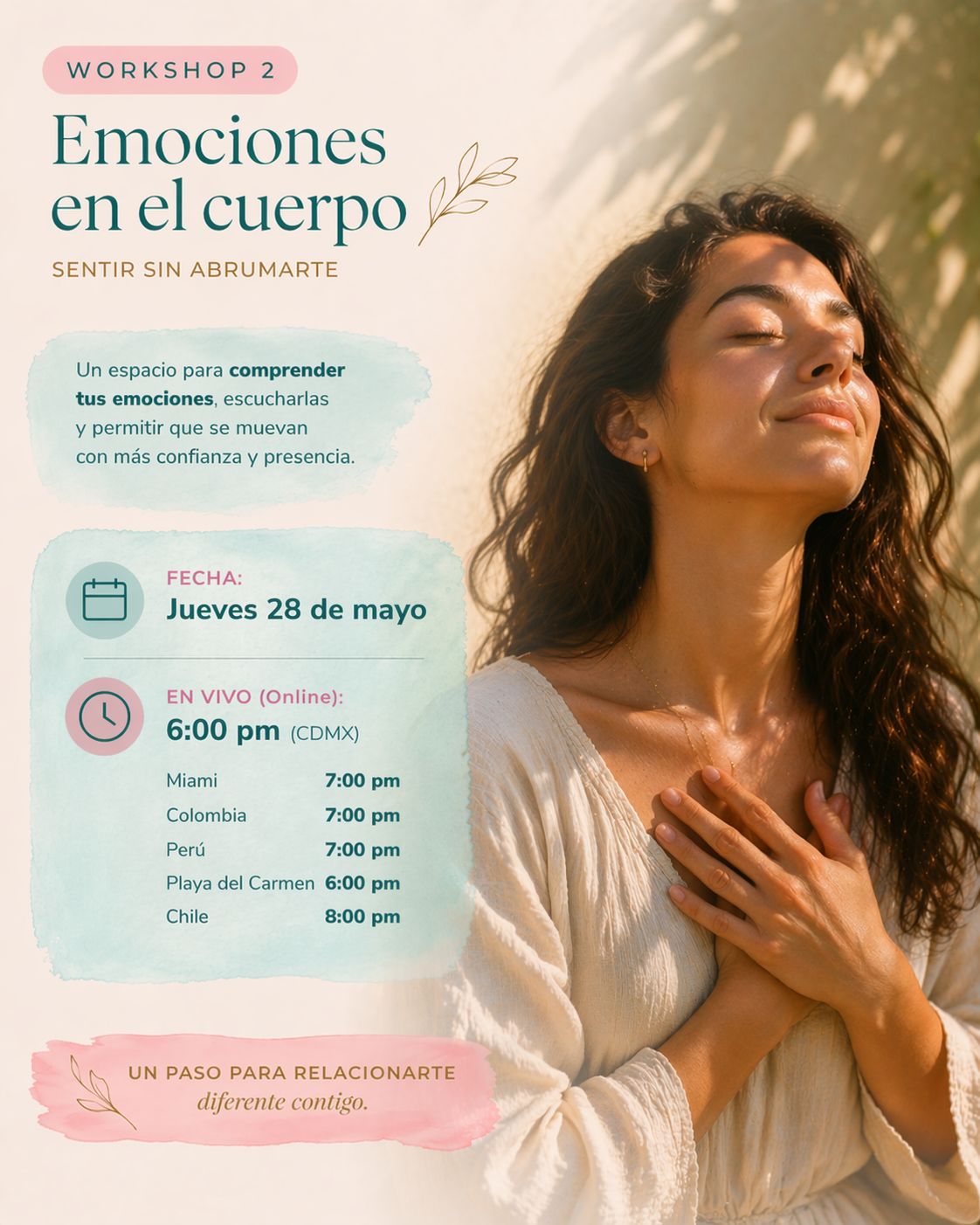
What Are Somatic Practices? Before You Continue Reading... Don't answer yet. Just observe. As your eyes move across these words, where is your body supported? Don't change your posture. Don't breathe more deeply. Don't try to relax. Just notice. Where does the weight of your feet rest? Is there any part of your body that you barely noticed a few seconds ago and that is now beginning to make itself known? Perhaps nothing extraordinary happens. And that is precisely where somatics begins. Not in changing the experience. But in discovering that something was always happening, even when we were not looking. Science Explains A Somatic Practice Does Not Try to Change Who You Are. It Tries to Change Where You Observe Yourself From. There is a question that appears again and again when someone first hears the expression somatic practice. "What am I supposed to do?" The question is understandable. We live in a culture where almost every form of learning begins with an instruction. Do this. Avoid that. Breathe this way. Correct your posture. Practice for twenty minutes. Improve. Optimize. Move forward. Somatic practices emerged from a different place. Their first question is usually not:
What are you going to do? But: What are you perceiving while what you are already doing is happening? It may seem like a very small difference. And yet, it completely changes the direction of the experience. Imagine someone walking. They could learn a technique to walk more efficiently. That could certainly be valuable. But a somatic practice might begin by asking something else. Do you know how your feet find the ground? Have you ever noticed how your weight shifts from one leg to the other? What happens in your breathing when you walk faster? What changes in your neck when you stop looking at your phone and lift your gaze toward the horizon? These are not questions that need to be answered correctly. They are questions meant to awaken an experience. And here we encounter one of the deepest differences between a practice oriented toward performance and one oriented toward perception. The first tries to produce a change. The second tries to reveal something that was already happening. In recent decades, neuroscience has begun to better understand why this kind of body awareness is so interesting. We know that the brain does not receive information only from the outside world. It also maintains a constant dialogue with the inside of the organism. The position of the body. Muscle tension. Temperature. Balance. Breathing. Heart rate. Visceral sensations. All of this forms part of a continuous flow of information that participates in the way we construct our experience of the present moment. Somatic practices do not create this dialogue. That dialogue has never stopped. What they do is invite us to participate in it more consciously. And perhaps here an idea appears that deserves to be observed slowly. For centuries, we have learned to use attention primarily to look outward. We observe screens. People. Objects. Landscapes.
Problems to solve. Goals to achieve. Attention becomes a tool for intervening in the world. Somatic practices do not abandon that capacity. They simply recover another possibility. The possibility of directing attention toward the experience of being alive while life is happening. Not to correct it. Not to judge it. Not even to make it disappear. Simply to know it. In this sense, a somatic practice resembles less a technique and more a form of inquiry. It does not investigate the body in the way a laboratory would. It investigates experience. And every good investigation begins in the same way. With curiosity. Not with conclusions. Perhaps that is why so many people discover something unexpected when they begin this path. They thought they were going to learn how to control their bodies better. And they end up learning how to listen to them. They believed they were going to find answers. And they discover much more interesting questions. Not questions that create confusion. Questions that expand experience. What happens when I stop trying to immediately change what I am feeling? What appears when I observe a sensation with the same curiosity with which a scientist observes a phenomenon in nature? What part of me begins to reveal itself when I stop relating to my body as a problem that needs to be corrected? Perhaps these questions explain why so many people describe somatic practices as an experience of returning. Not because they return to the past. Nor because they return to an ideal version of themselves. But because, little by little, they return to a place they had never truly left. The only place from which all life has ever been lived. Their own body. And perhaps this is where somatics touches something that the great traditions of self-knowledge have sensed for centuries. Not because it offers spiritual answers. But because it shares the same direction.
Instead of taking us farther and farther away from ourselves, it invites us to travel the path back. Not to find a hidden truth. But to discover that, while we were searching for answers everywhere, a silent experience had been accompanying us from the beginning. The experience of being alive. The Research Behind This Article Some Ideas Are Not Born to Answer Questions. They Are Born to Change the Way We Ask Them. When we look at the history of somatic practices, it is tempting to ask which one is the best. Which one works best? Which has the strongest scientific support? Which produces the best results? These are legitimate questions. Contemporary research continues to explore them. There are studies on the Feldenkrais Method, Body-Mind Centering, the Alexander Technique, Somatic Experiencing, different forms of movement education, and other approaches that investigate how perception, movement, and body awareness participate in human experience. That research will continue to grow in the years ahead. And it is important that it does. Science helps us distinguish between valuable intuitions, effective practices, and claims that still require stronger evidence. But perhaps there is an even more interesting question. What do practices born in such different places, periods, and contexts have in common? When we look closely at their histories, a surprising pattern appears. None began by asking how to control the body better. Most began by asking how to understand it better. They were not trying to manufacture a more efficient version of the human being. They were trying to understand how we learn. How we perceive. How our experience changes when our attention changes. How movement modifies awareness. How awareness transforms movement. In other words, they all seemed to revolve around the same intuition. The body is not only something we make move. It is also where we learn how to live. Perhaps that is why somatic practices continue to evolve.
They are not a closed method. They are a territory of inquiry. And, like any living territory, they will continue to transform as neuroscience, biology, psychology, cognitive sciences, and human experience continue to enter into dialogue with one another. At Sentido Somático, we want to participate in that conversation with a deeply simple attitude. We do not seek to convince you to adopt a particular technique. Nor do we believe there is a single valid path for everyone. Our commitment is something different. To create a space where science can meet experience. Where academic knowledge can meet everyday curiosity. Where the body can stop being merely an object we try to understand and become once again a companion with whom we learn to live. Because perhaps that is the true contribution of somatics. Not offering a new collection of exercises. But reminding us that there is a difference between moving a body and inhabiting it. And that difference cannot be learned through reading alone. It needs to be lived. Perhaps that is why this article does not really end here. In a sense, it is only beginning. Because words have a limit. They take us only so far. Beyond that point, experience appears. And no experience can be lived by another person. Only by you. So, before you close this page, I would like to leave you with one final invitation. Not to do a practice. Not to change your breathing. Not to adopt a different posture. Just an invitation to pause for a few seconds. As you read these final lines, feel the weight of your body. Without changing anything. Just notice that you are here. Breathing. Reading. Alive. Perhaps you discover that nothing extraordinary has happened. And yet, something has changed. Not the body. The way you relate to it.
And perhaps that is one of the most subtle and, at the same time, profound transformations that a somatic practice can offer. Not adding something that was previously missing. But allowing a different quality of attention to reveal a richness that has always been present. Because, in the end, somatic practices do not teach us to become someone else. They teach us to meet, again and again, the one person with whom we have shared every moment of our existence. Ourselves. Fundamental References Foundational Authors of Somatic Education Thomas Hanna (1928-1990) An American philosopher who coined the term Somatics in 1976. He proposed understanding the body through first-person experience—the soma—and brought together various disciplines of movement education and body awarenessunder a common concept. Moshe Feldenkrais (1904-1984) A physicist, engineer, and creator of the Feldenkrais Method. His work demonstrated how learning, movement, and perception can reorganize the way a person inhabits their body. Elsa Gindler (1885-1961) A German educator considered one of the most important precursors of somatic education. She explored the relationship between attention, breathing, movement, and lived experience. Charlotte Selver (1901-2003) Developed Sensory Awareness, spreading the exploration of perception as a form of learning and presence.